 Guest Blogger ALICE MATAGORA is the author of You Are My Miracle (October 2025), and How to Save the World: Disciplemaking Made Simple (August 2022). She has contributed to other works, such as Clear Mind, Peaceful Heart: 50 Devotions for Sleeping Well in a World Full of Worry and The Message Women’s Devotional Bible. She has worked with The Navigators in disciplemaking ministry for over 20 years and is currently the Director of Leader Development.
Proverbs 18:21 says, “The tongue has the power of life and death, and those who love it will eat its fruit.” Our words are powerful and yield fruit according to what is sown. When we speak words of life, we produce life-giving fruit that flourishes. When we speak words of death, we produce fruit that destroys. In my experience as a licensed marriage and family therapist, a mother, and as a child (though it’s been a while…), I am convinced that those whose words hold the most power in shaping our identities and sense of belonging are the people closest to us – our parents.
In His wisdom, God has entrusted our children to us to steward their development and growth. He knows that we are His best for our children, and He knows that our children are His best for shaping us to become more like Jesus. As parents, we bear the weighty responsibility of laying a critical foundation of belovedness, unconditional love, and worthiness upon which the rest of our children’s lives and sense of selves will build. If this foundation is shaky, then everything else that rests on it will be as well.
Are we letting our children come to their own conclusions from the world about their identities and belovedness, or are we intentionally shaping them? How can we as parents lay this solid foundation in our children? Here are some practical ideas to get started.
Praise the positive. There is much research that supports that positive reinforcement is far more effective in increasing desirable behavior in children than punishment or criticism is in decreasing undesirable behavior. Being praised feels good! For example, “I noticed that you put your shoes away on the shoe rack today. Great job, thank you for being so mindful!” encourages a child to keep putting their shoes on the shoe rack; versus, “You’re so lazy, why can’t you remember to put your shoes back on the rack? You’re always leaving a big mess!” Sure, they may comply and put their shoes away, but at what cost to their identity and sense of self?
This isn’t to say that we can’t correct our children. Of course, if there is something they are doing or an attitude that could be harmful to themselves or others, the most important thing is to create safety and provide limits. How we approach correcting and shepherding our children to make good choices is important. Are we using threats, punishments, and negatively labelling our children in order to control their behavior? Or are we patiently correcting with unconditional love and affirming their truest identity as a beloved child of God who is still learning?
Praising the positive requires us to pay attention. If the only time our children are hearing from us is when we notice they are doing something wrong, they can begin to form negative identity statements – “I can’t do anything right.” “My parents don’t love me because I keep messing up.” – which, in some cases, develops into performance anxiety and depression. The problem is, we don’t often notice when things are going well unless we go out of the way to do so – we are too busy with life or too distracted by our phones. Try to catch your kids in the act of doing good…and encourage them to keep going! Kids want to be caught doing good!
Along those lines, affirm who God created your child to be, shadow sides and all. Many times, the negative behaviors we see in our kids are a shadow side of a God-given strength. As parents, it is our responsibility to refine some of the rough edges that come with these raw gifts and talents so that they can be more adaptive. For example, God has created my son to be naturally curious. He wants to know how things work. One of the side effects of his curiosity is that he has a propensity to irreparably take things apart. In my human nature, what I want to yell at times is, “Why are you so destructive?” What I don’t want to do is squelch this God-given, God-designed curiosity in my boy. Do I want him to live out of the identity that he is destructive and that’s bad, or that he is curious and that’s good? So, I take a deep breath, then say, “I love how curious you are! But remember, we can’t just take things apart. What can we do differently next time?”
In moments of high tension, exercise self-control. If you are afraid, you may say something you will regret in the heat of the moment, take a time-out. Proverbs 12:18 says, “The words of the reckless pierce like swords, but the tongue of the wise brings healing.” It is difficult to take back words that have been carelessly thrown. Once they have done their damage, it’ll take time, and possibly even therapy, to recover from them, even if you come to realize you didn’t mean them in the first place.
And if it all falls apart, repair and debrief when the dust has settled. There is the saying, “Children are excellent observers but poor interpreters.” There are times when I need to ask for forgiveness or bring clarity to my kids because I was upset about something completely unrelated to them, and then I lost my patience with them. In those moments, I want them to know beyond what they could possibly interpret that it wasn’t their fault I was upset with them. Or, in vulnerable moments after big meltdowns, when they are wondering the most whether they are still loved, I make an extra effort to remind them of their belovedness, and that nothing they say or do can ever remove my love, and that, more importantly, God’s love, from them.
Finally, speak of your child’s belovedness and speak it often. Give Satan no room to whisper lies that they are unwanted, unworthy, or unlovable. Speak a blessing over your children before they leave for school in the morning. Pray for them during the day. Welcome them home with excitement at their presence. In a world full of many competing voices, let ours be the loudest, the most frequent, and the most affirming. May our words be the building blocks of worthiness and belovedness that will lay a solid foundation for the rest of their lives.
Alice Matagora lives in Southern California with her husband, RJ; her children, Regi and Clementine; and her Daisy dog. In her free time, she enjoys sleeping, eating delicious food, trying new delicious food, being in nature, throwing sticks and rocks in the creek with her kids, silly dancing with her family, working out, and nerdery.
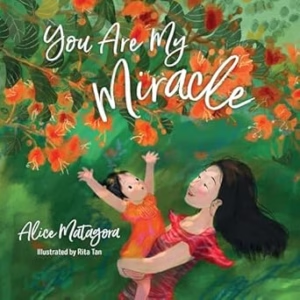
She is a licensed marriage and family therapist. Combining her professional experience and passion for disciplemaking, Alice’s first book, How to Save the World: Disciplemaking Made Simple, seeks to equip and empower everyday people to make disciples of Jesus wherever they live, work, and play. Her most recent book, released in October 2025, You Are My Miracle is her first book for children.
CLICK to learn more about Alice’s books on Amazon.
* * * * * * * *